
Tesla Optimus production crossed a line this month that no amount of stage demonstrations could cross for it. Chinese industrial reporting says the company placed bulk component purchase orders in early September covering roughly 5,000 robots.
That is a modest number for a company that builds close to two million cars a year. It is a very large number for a humanoid program that had been buying parts in batches of dozens.
Tesla has not confirmed the orders, and the next-generation hardware still has not been shown in public. What can be checked is the manufacturing sequence the reports describe, and that sequence looks like the way Tesla has opened every other product line it owns.

A line that spent the summer being debugged
The report came from Jiemian News, which cited channel checks inside Tesla’s core manufacturing network. Its account is less about the order size than about what had to happen first.
According to that account, the primary humanoid assembly line at Tesla’s Fremont plant began equipment debugging in July. Preliminary trial phases finished around the middle of August.
The yield improvements achieved during that summer setup are described as the operational prerequisite for releasing thousands of commercial-grade parts. In other words, the purchase order is a consequence of the line working, not a bet placed before it.
That ordering matters because it is the opposite of how humanoid programs are usually announced. Most are announced at the demonstration and financed on the promise; here the demonstration has not happened and the parts are already moving.
Tesla put Optimus on its capital expenditure ledger in its fourth-quarter results and earmarked floor space at Fremont for it. The long-term figure attached to that floor space is an installed capacity of one million units a year.
Supply-chain accounts put the internal baseline for 2026 at 10,000 to 20,000 robots for Tesla’s own use. Analysts cited in the same reporting expect weekly run rates to pass 2,500 units toward the end of the year if the first 5,000 sets clear assembly without major re-tooling.
Those are conditional numbers and should be read as such. The condition is a real one, though, and it is the kind of condition a factory answers in weeks rather than years.

Tesla Optimus production runs on parts nobody sells off the shelf
The segments named in the reports are actuators, planetary roller screws and machine vision. That list is not arbitrary. It is exactly the set of components a walking machine needs and a car does not.
Humanoid limbs cannot run on standard industrial servo hardware. A robot arm bolted to a factory floor can be heavy and slow; a leg that carries its own power supply cannot.
Tesla’s engineering leadership has been recruiting specifically around gear design and motor force density, which is the polite way of saying the joints have to deliver more torque per kilogram than anything currently catalogued.
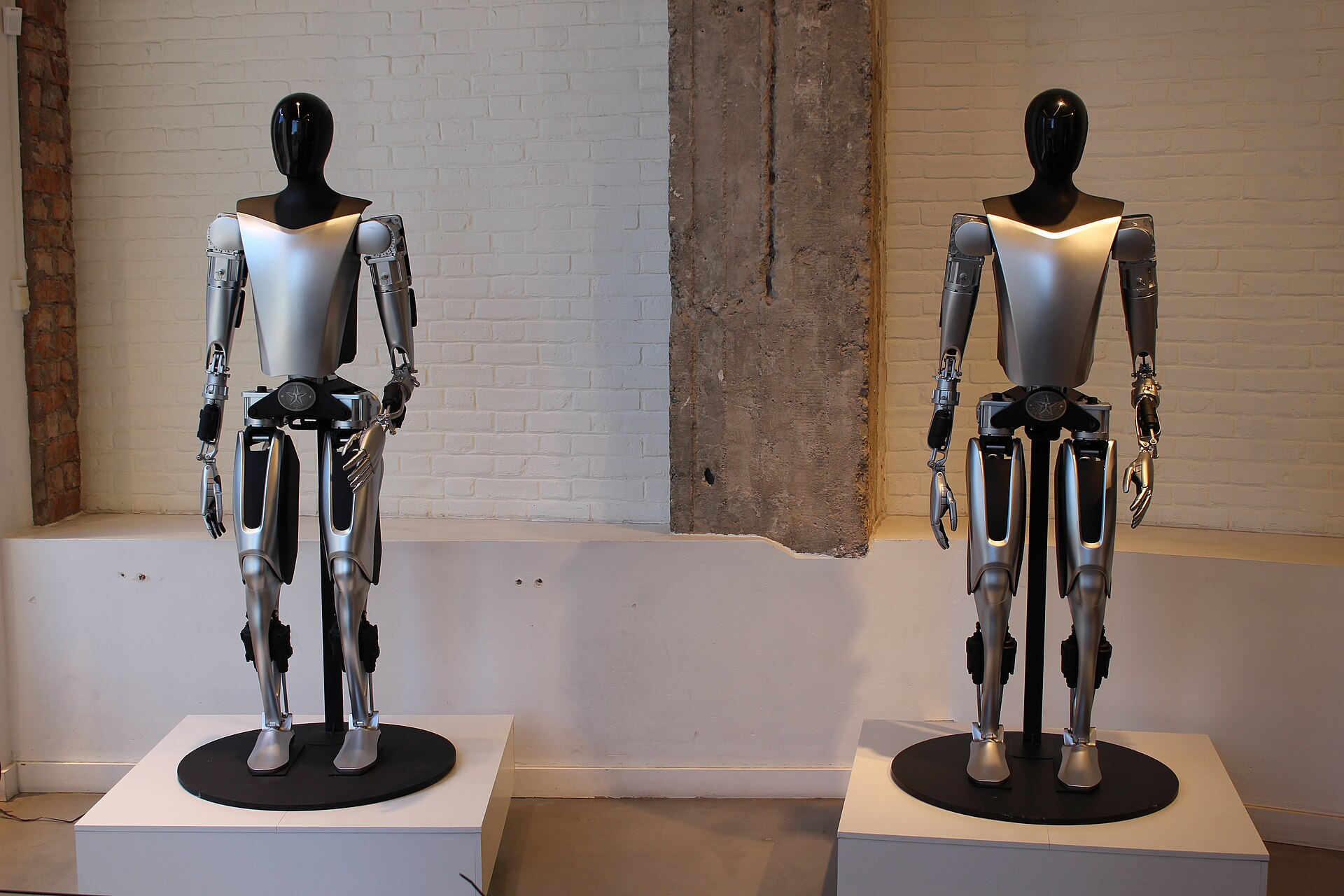
The hand is the hardest part of that. Tesla’s redesigned hand and forearm assembly carries 25 actuators, and the tolerances involved stretch what global precision-machining capacity can currently deliver.
Chinese suppliers have been building toward this. Teslarati reported in October 2025 that Tesla had placed a 5 billion RMB order, about 685 million dollars, for linear actuators from Sanhua Intelligent Controls, a firm that already supplies parts for Tesla’s cars.
Green Harmonic has a Suzhou plant coming online in 2026 with a stated annual capacity of 500,000 units, enough to cover an initial Optimus ramp on its own. Machine-vision supplier Orbbec sits in the same cluster.
The reason a multi-thousand-unit order reads as significant to those suppliers is that it implies a design freeze. Tier-one vendors do not dedicate tooling lines to a part that is still changing shape.
This is the same logic Tesla applied to cells, to large castings and to its own driving computers. Owning the awkward part of the supply chain early is expensive, and it is the reason the company can move when a line finally works. The longer history of how factories reorganize themselves is worth reading alongside this.
What the company has not said yet
The gaps are worth stating plainly. Tesla missed its own first-quarter deadline for a public debut of the third-generation robot, and the updated hardware has stayed behind closed doors since.
A Tesla China representative said there was no official information about the order that could be shared externally. A Sanhua representative said only that the robotics business was progressing smoothly.
Enthusiastic second-hand accounts have filled that silence. Jason Calacanis said on the All-In Podcast that Musk showed him unreleased footage and that he had to ask whether it was computer-generated. Claims from close associates are a recurring feature of Tesla’s development cycles and are not evidence.
Musk himself has been more measured, describing the current fleet as primarily a way to learn and collect data rather than to produce measurable output. As of August 2026 the company had disclosed no external customers and no unit sales.
Set against that, the thing Tesla has actually done is unusual. No other carmaker has put a humanoid line on its capital expenditure ledger, converted vehicle floor space to it, and started clearing production-grade parts through it.
Rivals building humanoids are mostly buying their motion hardware from the same handful of vendors Tesla is now booking capacity from. Being first in that queue is worth more than being first on stage.
The reveal will come, and it will be judged on how the machine moves. The more informative number will be the one on the loading dock, and for the first time that number is large enough to check.
References
Humanoids Daily, September 7, 2026 · Jiemian News, September 2026 · Teslarati, October 15, 2025 · Tesla fourth-quarter results and capital expenditure disclosures.


