Caption: The facade of the New York Stock Exchange on Wall Street. On August 14 (local time), U.S. stocks took a breather after hitting a record high the day before.
Source: Pexels (free license)
1. U.S. Markets & the Fed
U.S. stocks closed slightly lower on Friday, August 14, pulling back after all three major indexes hit record territory the day before. The S&P 500 and the Dow each slipped about 0.2%, while the Nasdaq Composite fell roughly 0.3-0.5%.
Even so, on a weekly basis the S&P 500 and Nasdaq extended their winning streak to a third straight week, the longest such run since April. A day earlier, on the 13th, softer-than-expected July producer price index (PPI) data eased fears of another rate hike, sending the S&P 500 above 7,800 for the first time.
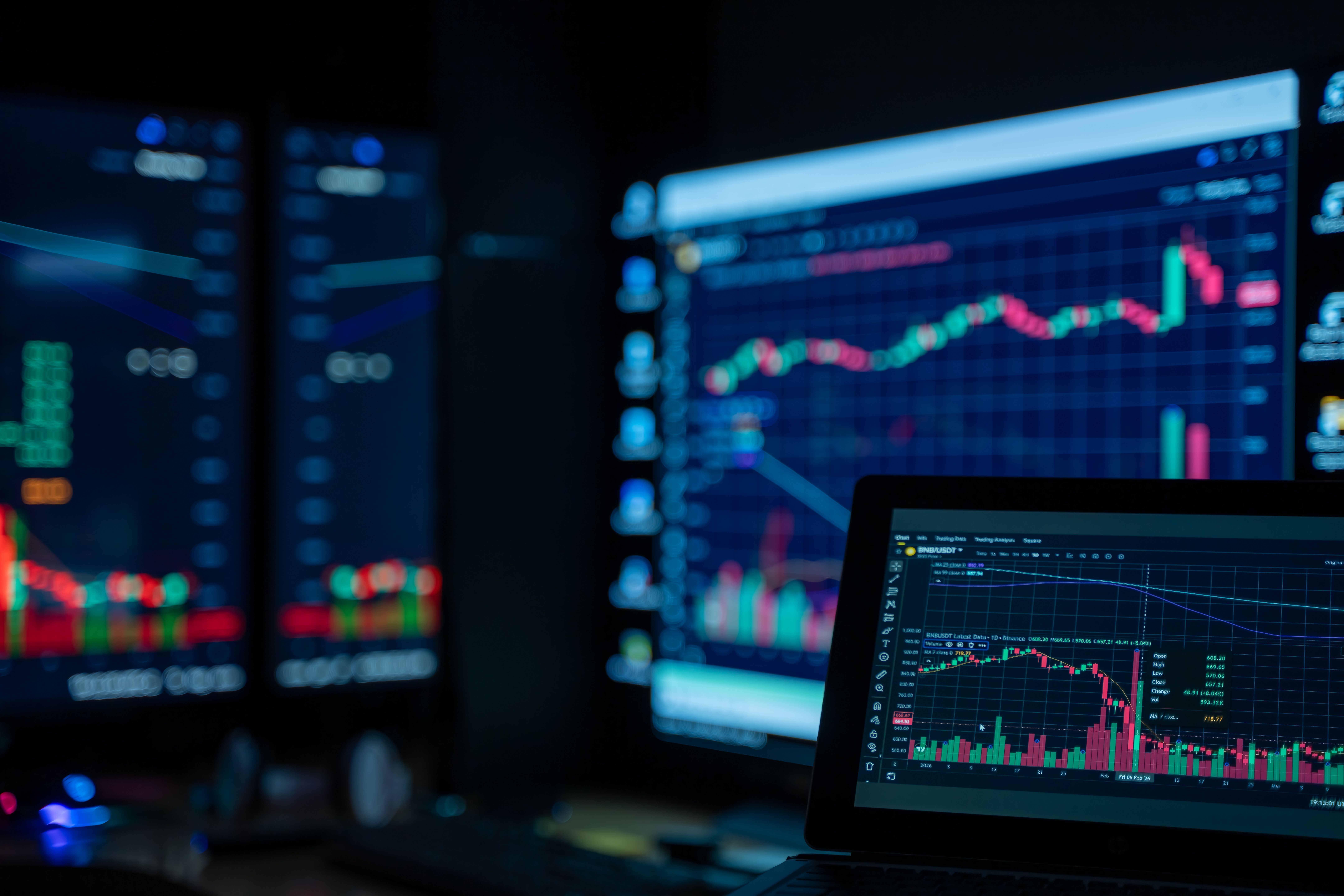
Caption: Stock charts displayed across multiple screens. Weak July retail sales and a soft consumer sentiment reading knocked stocks off their record highs on the 14th.
Source: Pexels (free license)
Soft consumer data dragged indexes lower on the 14th. July retail sales fell 0.6% from the prior month, the first decline in nine months and the biggest drop in 14 months, the opposite of the 0.1% increase economists had expected.
The University of Michigan’s preliminary August consumer sentiment index came in at 51.0, below both the 54.5 consensus and July’s 55.2 reading. One-year inflation expectations actually rose to 4.3%, an uncomfortable combination of weakening confidence and persistent inflation worries.
Middle East tensions added another headwind. Oil shipments through the Strait of Hormuz have effectively ground to a halt, and the U.S. said it could maintain an indefinite naval blockade of Iran, sending crude prices up roughly 6% for the week. Brent crude traded near $87 a barrel.
The Federal Reserve held its benchmark rate at 3.50%-3.75% at the July 29 FOMC meeting in a 9-3 vote. Chair Kevin Warsh reaffirmed that keeping inflation in check remains the top priority. With no policy meeting scheduled in August, attention now turns to the annual Jackson Hole economic symposium.
Sources: The Motley Fool, Detroit News, Yahoo Finance/Zacks, CNBC
2. AI Software: Apple Trains Its Own China AI Model With Alibaba’s Help

Caption: An image representing artificial intelligence technology. Reuters reported on the 14th that Apple trained its own large language model for the China market with support from Alibaba.
Source: Pexels (free license)
Reuters reported on the 14th that Apple has trained its own large language model (LLM) for the China market rather than relying on a third-party model. The LLM was developed with help from Alibaba, according to the report.
The move marks a break from Apple’s earlier strategy of relying on a domestic partner’s model in China, and Apple Intelligence features are expected to roll out in the country within the coming months. The report describes this as a “dual-track” strategy combining Apple’s own model with a third-party one, Alibaba’s Qwen.
Notably, this makes Apple the first foreign company Beijing has cleared to deploy its own proprietary AI model in China. Apple had earlier agreed with Chinese regulators to incorporate Alibaba’s Qwen model into Apple Intelligence, and on the 10th briefly published (then quickly removed) a support guide explaining how Mac users could connect Siri and Writing Tools to Qwen.
Sources: Reuters, MacRumors
3. Semiconductors & AI Infrastructure: SK hynix Sets Up a “Beyond Memory” Growth Team
Caption: A close-up of a microprocessor circuit board. SK hynix has formed a dedicated team to extend its HBM leadership into a broader role across AI infrastructure.
Source: Pexels (free license)
DigiTimes reported on the 14th that SK hynix has set up a dedicated team to explore growth opportunities beyond its core memory business, placing a senior group executive in charge. The move is seen as an effort to turn the company’s leadership in high-bandwidth memory (HBM) into a wider role across AI infrastructure.
Earlier, on the 7th, SK hynix’s board approved a combined 54.3 trillion won ($38 billion) investment in a new DRAM fab in Yongin (Y2, about 24.6 trillion won) and a NAND flash plant in Cheongju (M17, about 13.4 trillion won). Both facilities will produce the HBM-grade DRAM and enterprise NAND that AI data centers need most, with production slated to begin in 2028-2029.
SK hynix has also struck a long-term partnership with Nvidia to jointly develop and supply next-generation AI memory. According to market data, SK hynix held a 58% share of the HBM market in the first quarter, the global leader, with Samsung Electronics and Micron each holding 21%.
Sources: DigiTimes, SK hynix Newsroom
4. M7 & Big Tech: Nearly $1.5 Trillion in AI Infrastructure Commitments
Caption: Rows of active server racks inside a data center. A report citing Financial Times analysis published on the 14th found that Big Tech’s spending commitments on AI infrastructure are nearing $1.5 trillion.
Source: Pexels (free license)
A report citing Financial Times analysis, published on the 14th, found that Alphabet, Microsoft, Amazon, Nvidia, Oracle and Meta have amassed nearly $1.5 trillion in purchase commitments tied to computing infrastructure, chips, data-center capacity and energy. The analysis suggests the center of gravity in the AI race is shifting from building smarter models to a broader contest over chips, data centers, energy, autonomous systems and security.
Behind this wave of spending is cloud demand strong enough to show up in earnings. In its Q2 results announced on July 30, Amazon said AWS revenue grew 36.7-37% year over year, its fastest pace in 18 quarters. CEO Andy Jassy said both cloud and AI demand are strengthening simultaneously.
Amazon’s total revenue that quarter topped $200 billion for the first time, at $200.6 billion, while operating income rose 43% to $27.5 billion. Amazon shares jumped roughly 9% in after-hours trading the day the results were released.
Sources: techstartups.com (citing FT analysis), Yahoo Finance, CNBC
5. EV & Batteries: BYD Holds Its Lead in China as Tesla Falls Out of the Top 10

Caption: An electric vehicle charging. According to China Passenger Car Association (CPCA) data, BYD held the No. 1 spot in China’s NEV retail market in July with a 23.5% share, while Tesla dropped out of the top 10 amid weak sales.
Source: Pexels (free license)
According to CPCA data cited in a report on the 13th, BYD remained China’s top NEV retailer in July with 223,461 units sold, a 23.5% share. That was down 18.6% year over year, but its lead over second-place Geely (11.1%) actually widened.
Tesla, meanwhile, sold just 27,249 units in China in July, dropping out of the top 10 after holding the No. 5 spot for two straight months. Exports from its Shanghai plant hit a record high instead, a sign the company’s mix is tilting further toward exports over domestic sales.
Chinese makers also continue to dominate the battery market. According to SNE Research, CATL and BYD held global EV battery market shares of 39.9% and 14.4%, respectively, in the first half of 2026, a combined 54.3%. Seven of the top 10 global suppliers are Chinese companies, together accounting for 72.4% of the market. LG Energy Solution held on to third place with 8.6%, though its share slipped from a year earlier.
Sources: CnEVPost (citing CPCA and SNE Research data)