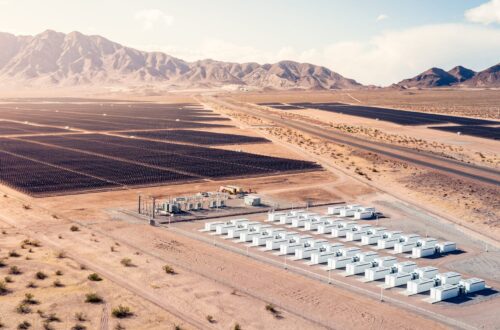
The Tesla Megapack 3 is now rolling off a line in Brookshire, a small city just west of Houston, and the timing is the interesting part. The factory went from bare ground to production in about sixteen months, and it is designed to build 50GWh of storage a year for one product only.
Six days before that story got its full technical write-up, the rules of the American grid changed. An executive order signed on 26 August blocks certain foreign-made batteries, inverters and transformers from connecting to the bulk power system, and analysts spent the following week working out how many projects it strands.
Those two facts belong in the same sentence. A company that spent two years moving its cell supply toward American factories now has a plant running in Texas at exactly the moment imported hardware became a liability. That is worth walking through slowly.

What a 28-foot container now holds, and why that number matters
Grid batteries are sold by the container. The unit that matters is how many megawatt-hours you can get inside one steel box, because the box is what has to be trucked, permitted, poured a foundation for and wired up.
The previous generation, the Megapack 2 XL, held 3.9MWh in most configurations and 4.3MWh in one. The new unit holds 5MWh in the same 28-foot footprint. That is roughly 28 per cent more energy in a box of the same size.
The reason is not exotic. Tesla moved to larger 2.8-litre cells, which raises the energy per cell and, as a side effect, cuts the number of thermal-system connection points by 78 per cent. Fewer joints in a cooling loop means fewer places for a leak to start.
The other numbers moved further than the capacity did. Cycle life goes from 3,000 to 5,000 cycles up to more than 10,000. Calendar life goes from 15 to 20 years up to 25. The warranty goes from 15 years to 20. Operating range widens from minus 30 to 50 degrees Celsius out to minus 40 to 60.

Round-trip efficiency is the one place the new unit does not sweep the board. The Megapack 3 is rated at 92.5 per cent; the four-hour Megapack 2 XL configuration was 93.7. That is a real trade, and it is the kind of honest detail a spec sheet usually buries.
The bigger change is not the container at all. It is the Megablock, which packs four Megapack 3 units with their transformer and switchgear into one pre-engineered 20MWh platform, and it exists because of a problem nobody outside the industry thinks about.
A standalone Megapack needs to be wired to a medium-voltage transformer, and that can mean up to 24 cable connections per pack. A Megablock needs three busbar connections per pack. The claim that follows is 23 per cent less installation time, 40 per cent lower construction cost, and 1GWh deployed in 20 days.
If you have read our piece on how Ford rebuilt a factory to take cost out of a pickup, the logic will look familiar. The saving is not in the cell. It is in everything that surrounds the cell.
The Tesla Megapack 3 arrives in a market that just changed its rules
The executive order signed on 26 August declares a national emergency over foreign-made grid equipment and bars covered hardware from connecting to transmission lines of 69kV and above. It reaches 24 countries on American arms-embargo and sanctions lists, and the one that matters commercially is China.
The Energy Department has 120 days to implement it. Energy Secretary Chris Wright also gets discretion over the continued use, servicing and updating of equipment that was already installed before the effective date, which is the clause developers are reading most nervously.
BloombergNEF told Utility Dive that storage faces more near-term risk than any other affected industry. Zoe Zakrzewska, the firm’s trade and supply chains analyst, put it bluntly: the earlier foreign-entity rules left Chinese firms some room to adapt, but this order can shut them out for good.

The scale of the exposure is easy to understate. The International Energy Agency puts China at 80 per cent of global lithium-ion supply chain production capacity. BNEF estimates Chinese companies supplied about 40 per cent of American inverter volumes in 2025, much of it routed through India and Southeast Asia.
Layer the Treasury Department’s foreign entity of concern guidance on top and the picture gets tighter still. To keep the production and investment tax credits, at least 55 per cent of a storage system by cost has to be domestically made in 2026, and that share rises in later years.
Which is where Tesla’s last two years of supply chain work stops looking like housekeeping and starts looking like a bet that paid. In March the company signed a 4.3 billion dollar agreement with LG Energy Solution for prismatic LFP cells built in Lansing, Michigan, specifically for Megapack production.
The contract runs from August 2027 through July 2030 with an extension option out to 2037. It is not a hedge against a rumour. It was signed five months before the order that made it look prescient.
Meanwhile the installed base keeps doing the quiet work of proving the product. Tesla has more than 77GWh of Megapack units operating worldwide at 99.3 per cent uptime, deployed 8.8GWh in the first quarter and 13.5GWh in the second, and signed a multi-year agreement with NatPower covering more than 25GWh across Italy and the United Kingdom.
What is still unsettled, and what to watch next
Start with the honest gaps. Tesla has not published a full Megapack 3 data sheet, so several of the comparisons above rest on figures reported by trade press rather than on a document you can download.
The Michigan cells do not start flowing until 2027, and LG Energy Solution is early in mass-producing prismatic LFP on American lines that are being converted from NMC pouch cells. Conversions of that kind are where schedules slip.
There is also the ordinary physics of logistics. Both the Megapack 3 and the Megapack 2 XL weigh about 38 tonnes, past the standard American 40-ton limit, so both need multi-axle trailers, permits, and in some states a police escort and restricted travel windows.

Cost per unit does not fall much either. Both generations land around 1.39 million dollars a container. The saving is that you need fewer containers for the same megawatt-hours, and therefore fewer foundations, fences, trenches and maintenance visits.
Adoption is early. Only a handful of projects have been confirmed on Megapack 3 so far, led by Neoen’s 907MWh grid-forming site at Goyder in South Australia, with two Belgian projects reported but not confirmed.
Competition is real too. Wood Mackenzie had Tesla as the largest BESS integrator last year; other trackers put Sungrow on top. Chinese integrators captured roughly three quarters of the global market, and the American order does nothing about the rest of the world.
So the thing to watch is not whether the Megapack 3 is a better box than the Megapack 2 XL. It clearly is. It is whether a product designed around fewer connections and fewer trips to site turns out to be the right shape for a market that has just been told where its parts have to come from. On the evidence so far, Tesla built for that market before it was asked to.
The same instinct shows up elsewhere in the company. We wrote earlier about how Tesla found 38 kilometres of range without touching the battery. The pattern is the same: the win comes from the part of the system everyone else treats as an afterthought.
References
Energy-Storage.News, “Under the hood: Inside Tesla’s Megapack 3 as Texas production begins,” Liam Critchley, 4 September 2026
Utility Dive, “Trump grid order likely to cause energy storage delays, cancellations: BloombergNEF,” Brian Martucci, 1 September 2026
Electrek, “Tesla starts Megapack 3 production with 28% more energy per unit,” 6 August 2026
CNBC, “Tesla to buy $4.3 billion of LG Energy battery cells made in Michigan,” 17 March 2026