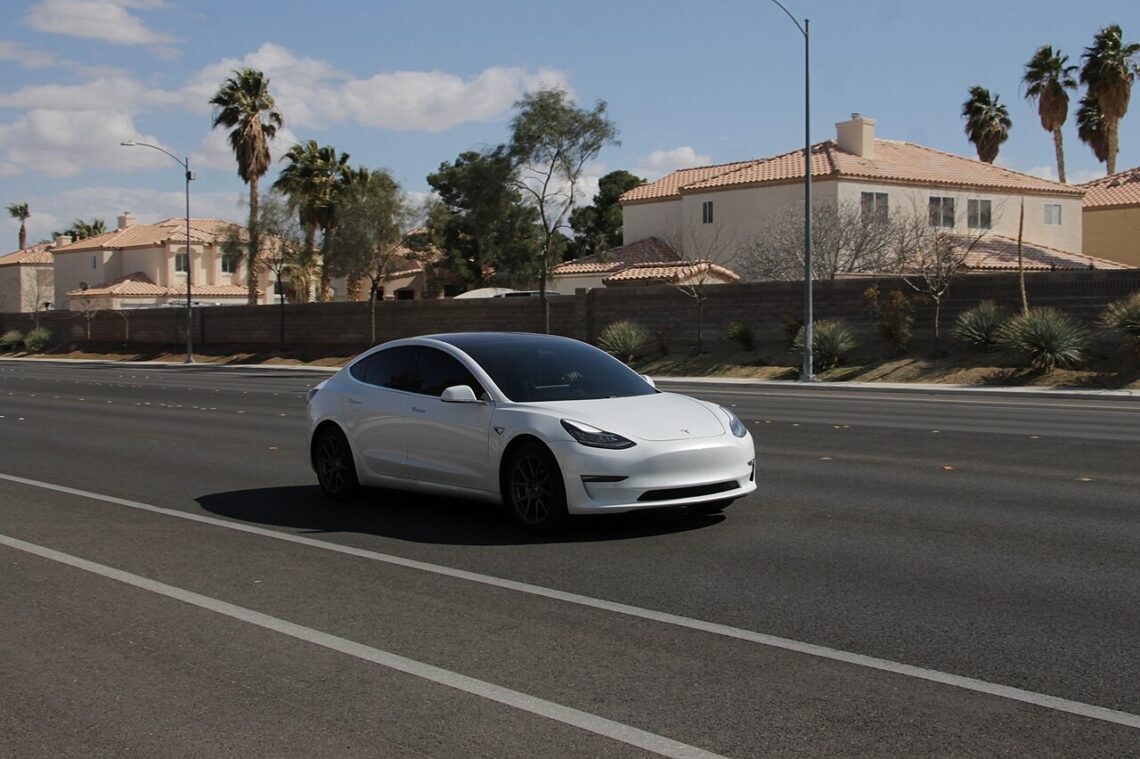
Tesla pushed a small line of text into the world on Friday morning, and it changes what a Tesla is doing while you are the one driving it. The company’s AI account said Full Self-Driving (Supervised) v14.3.9 was “starting to roll out shortly,” and that the release carries what Tesla called a new active safety feature set.
The substance is in one sentence. FSD Supervised, Tesla wrote, “can now activate on your behalf when an imminent collision is detected and Automatic Emergency Braking (AEB) may not be enough.” It may also engage, the company added, if it detects that you are heavily distracted or have accidentally switched FSD off.
Read that carefully and the shift is larger than a release note. Until now the driving software ran only when a driver asked for it. From this version, a slice of the same stack sits awake in the background during ordinary manual driving, watching, and is authorized to take the wheel.

What Tesla actually shipped on Friday morning
The distinction Tesla is drawing is between braking and steering. Automatic emergency braking, the feature almost every new car now carries, does exactly one thing: it slams on the brakes. It is a scalar response to a vector problem. If the gap ahead is long enough to stop in, AEB solves the situation. If it is not, AEB reduces the speed of the impact and nothing more.
What v14.3.9 adds is directional control. When the planner concludes that braking alone will not clear the obstacle, it can steer, and it can do so from a standing start of zero driver input.
The second trigger is the one that has drawn less attention and may matter more. Tesla says the system may also engage when it detects a heavily distracted driver, or when FSD has been disengaged by accident — a knee against the stalk, a hand brushing the wheel hard enough to cancel the mode without the driver noticing.
That is Tesla treating its own disengagement logic as a failure mode worth catching, which is an unusual thing for a manufacturer to say out loud.
It is also worth noting what Tesla is spending here. The v14 stack has been rolling out since April, and on 3 September the company said its Robotaxi fleet had crossed one million unsupervised miles. The software being asked to catch a distracted driver is the same software that has been driving with nobody in the seat.

Why steering can save a car that braking cannot
The reason a steering system can rescue a situation a braking system cannot comes down to arithmetic that has nothing to do with software.
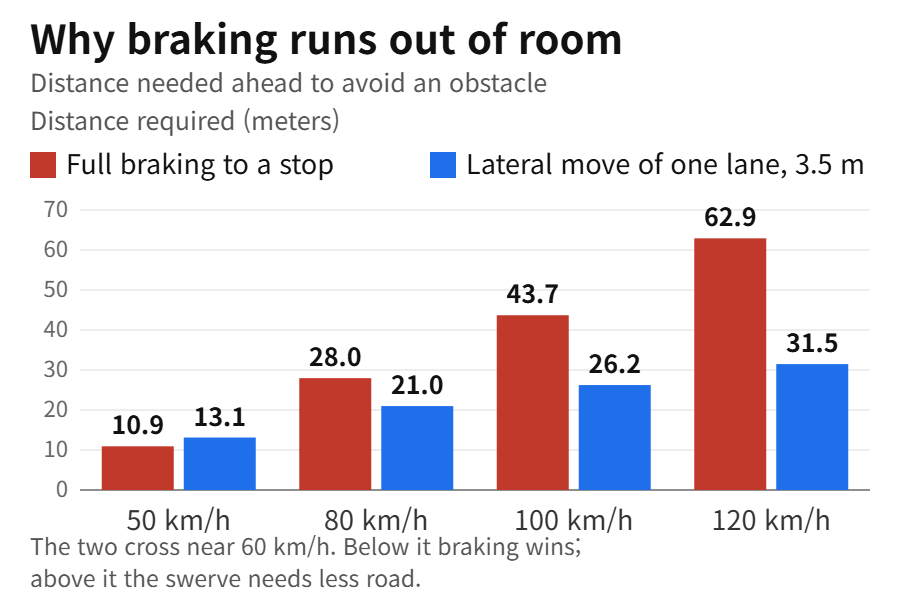
Stopping distance rises with the square of speed. Double your speed and you need roughly four times the room. Moving sideways by one lane width, by contrast, takes a fixed amount of time — a little under a second at the cornering grip a road tyre can deliver — so the distance it consumes rises only in proportion to speed.
Those two curves cross. Below roughly 60 km/h, braking wins and there is no argument. Above it, the car that swerves needs meaningfully less road than the car that stops, and the gap widens the faster you are going.
This is not a new insight, and Tesla is not the first to act on it. Ford and Mercedes-Benz both sell a function called Evasive Steering Assist; Volvo markets Steering Support within its City Safety suite; Euro NCAP has recommended autonomous emergency steering for years and its 2026 protocol tightened requirements on driver monitoring for drowsiness, distraction and impairment.
But those production systems, as their makers describe them, are mostly amplifiers. They sharpen a swerve the driver has already begun, adding torque and trajectory to a human decision. They do not initiate.
Tesla’s description is a different animal. The planner that has been driving cars without anyone in them decides, on its own, that this is the moment, and moves.
Regulation has not caught up with any of this, and it is worth being precise about why. The federal rule everyone points to, FMVSS No. 127, was finalised in May 2024 and requires automatic emergency braking, pedestrian AEB and forward collision warning on every light vehicle sold in the United States by 1 September 2029, with an extra year for small-volume manufacturers.
It sets real bars: no contact with a lead vehicle at up to 62 mph, pedestrian detection day and night up to 40 mph. NHTSA projects at least 360 lives saved and 24,000 injuries prevented each year.
Every one of those requirements is about braking. Nothing in the standard asks a car to steer, and nothing forbids it. What Tesla shipped on Friday sits entirely in that empty space, three years ahead of a mandate that will not cover it.
The number that decides whether this works
Everything now rests on one figure Tesla has not published: the false-positive rate.
A braking system that fires when it should not is unpleasant and occasionally dangerous. A steering system that fires when it should not puts a car somewhere its driver did not choose, at speed, possibly into a lane that is occupied. The consequences are not on the same scale, and Tesla knows it.
Electrek’s Fred Lambert, who has driven and documented this software for a decade, raised exactly this. He recorded v14.3.6 swerving toward an exit it had already passed in August, and Autopilot’s phantom braking has been a running complaint since 2021. His conclusion was not that the feature is wrong but that he wants a switch.
Tesla has not yet said whether there is one, nor has it explained how the planner decides that steering beats braking in a given frame. Those are fair questions and they will be asked loudly.
What is easy to lose in the argument is the size of the fleet Tesla is drawing on. No other manufacturer has a driving stack that has accumulated unsupervised miles at this scale, and no other manufacturer can push a change like this to millions of cars already on the road in a single week.
The competitors selling evasive steering assist today ship it in a package, on a trim, in a model year. Tesla is shipping a background guardian to cars people bought years ago, without asking them to subscribe to anything.
The honest framing is that this is the automation paradox arriving in the family car. A system that intervenes rarely, and correctly, teaches drivers to stop watching for the moment it is wrong. Aviation spent thirty years learning that lesson and it is the deepest problem in the field, older and larger than any one company.
Tesla did not create it and cannot solve it alone. What Tesla has done is decide that the safest place for its driving software is not parked behind a subscription, but awake in the background of every drive.
The rest of the industry has three years before a federal rule forces it to brake. The interesting question is how many of them will follow Tesla into the part of the problem the rule does not mention.
References
- Fred Lambert, “Tesla Full Self-Driving can now take over manual driving to avoid a collision,” Electrek, 4 September 2026.
- Tesla AI (@Tesla_AI), release note for FSD Supervised v14.3.9, 4 September 2026.
- Fred Lambert, “Tesla announces Robotaxi has driven 1 million unsupervised miles,” Electrek, 3 September 2026.
- NHTSA, Federal Motor Vehicle Safety Standard No. 127, Automatic Emergency Braking Systems for Light Vehicles, final rule, Federal Register, 2024.
- Euro NCAP, Assessment Protocol — Safety Assist / Safe Driving, 2026 revision.
- FAA, Safety Alert for Operators 17007, “Manual Flight Operations Proficiency,” 2017.