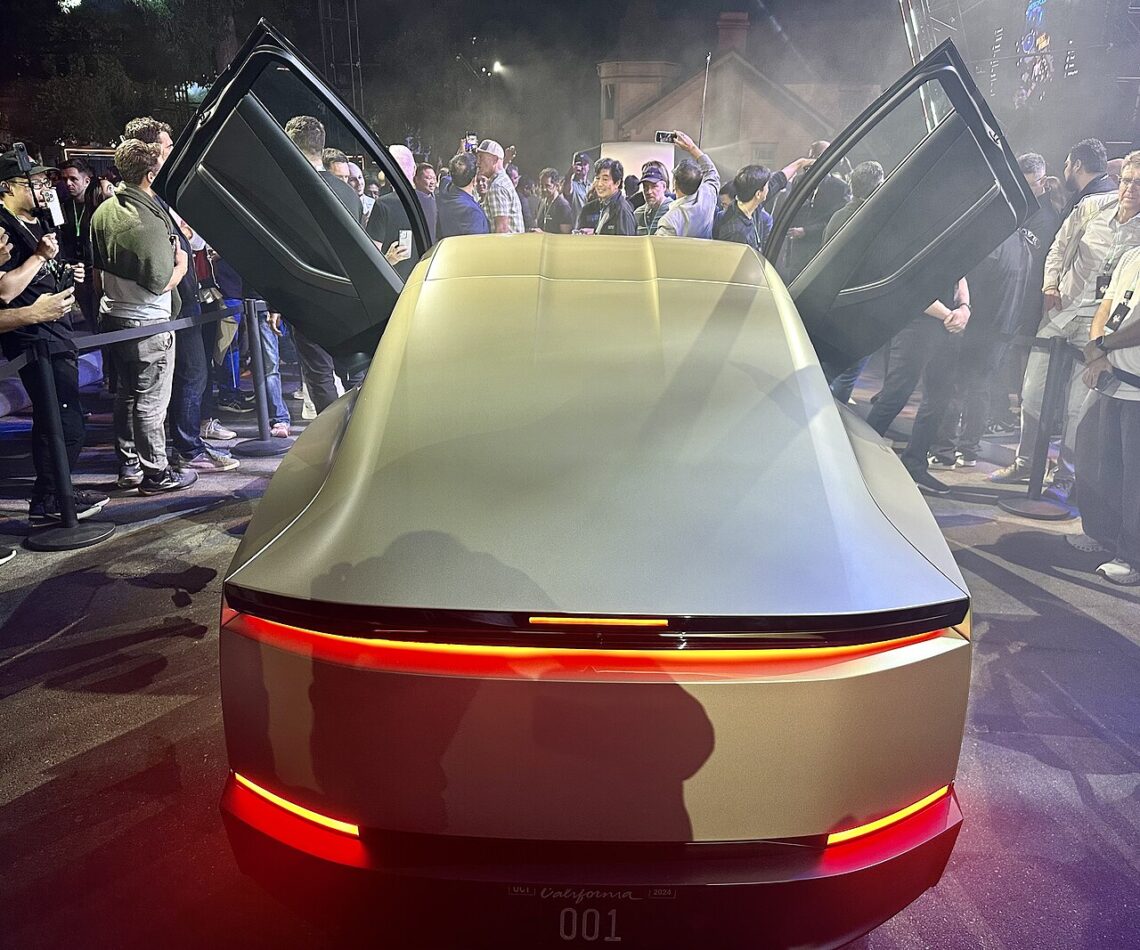
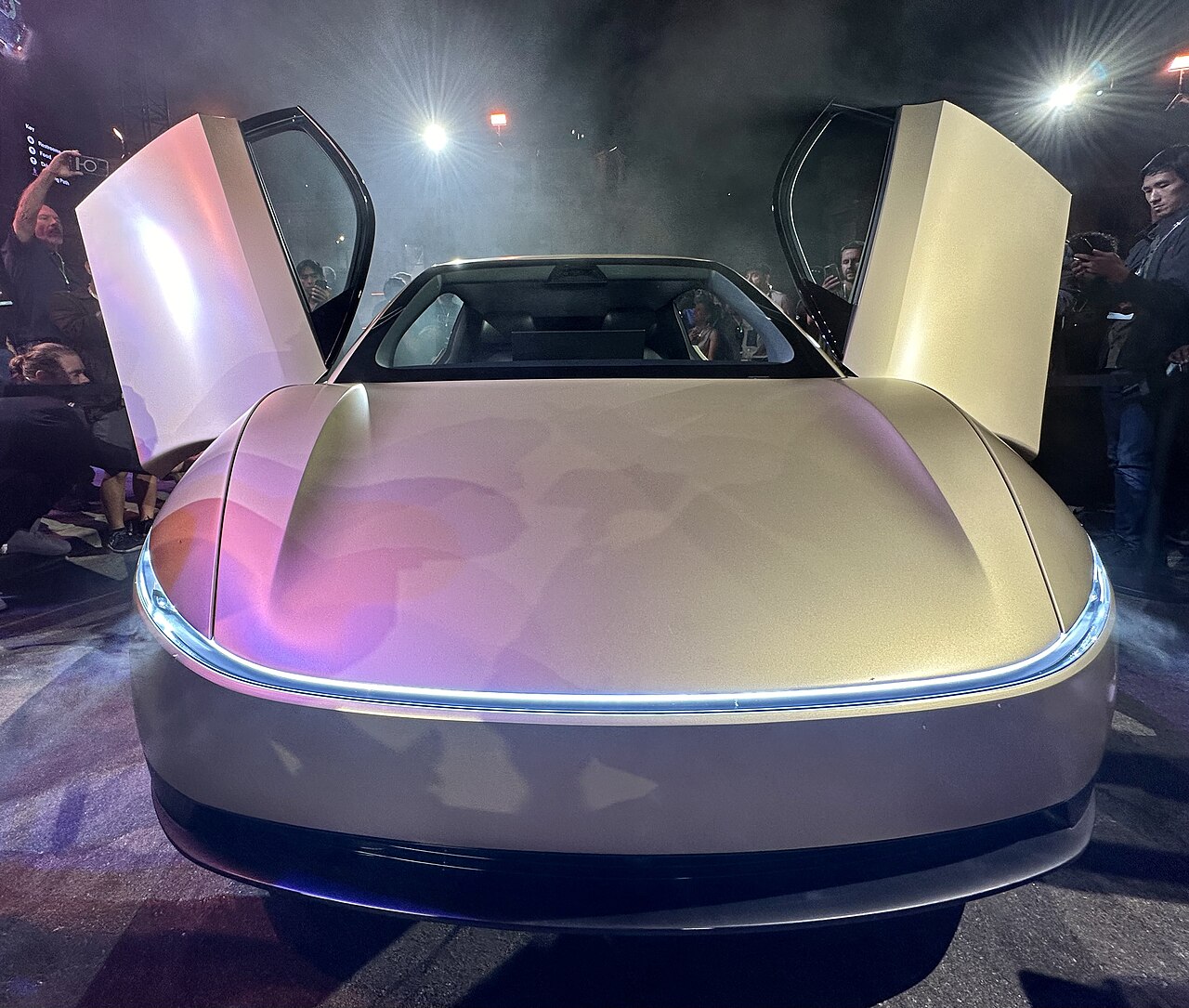
Tesla launched the production Cybercab in downtown Austin on the evening of 3 September, and the most striking thing about the event was how little of it looked like a product launch. There was no stage keynote, no livestream and no set of headline numbers read out by Elon Musk. Reuters noted that as of Thursday evening the company had posted no live footage and no executive had spoken publicly.
What Tesla did instead was quieter and, in its own way, more consequential. The company confirmed it had begun offering rides in limited areas of Austin in the two-seat Cybercab, a vehicle with no steering wheel and no pedals.
Guests at the invite-only event hailed cars to destinations of their choosing inside the existing geofence. The Robotaxi app was updated the same morning so that any rider in Austin now picks between a two-seat Cybercab and a four-seat Model Y before booking.
That is the shift worth paying attention to. For fifteen months Tesla driverless service has run on Model Ys, production SUVs with the driver seat still in them, converted for autonomy.
The Cybercab is the first vehicle the company has built from a blank sheet on the assumption that nobody will ever drive it, and the entire cost argument for robotaxis rests on that assumption being buildable. Austin is now the place where the argument gets tested with passengers rather than slides.
A launch measured in registrations rather than applause
Start with what physically exists. On the day of the event, the Texas autonomous vehicle registry listed 420 vehicles, of which 45 were Cybercabs registered to the Tesla robotaxi entity alongside 269 Model Ys. That is a pilot fleet, not a network, and Tesla has been candid about it.
Musk told investors the early production rate would be painfully slow before it becomes very fast, and he has said Cybercab revenue is unlikely to be material before 2027.
The build history behind those 45 cars is more interesting than the number. Pilot builds started at Giga Texas in February, volume manufacturing followed in April, and drone photography logged 245 finished units staged across the factory lots by mid-July, more than double the count five weeks earlier.
Independent research cited by industry analysts puts installed annual Cybercab capacity at Giga Texas above 125,000 units. The factory is not the bottleneck.
The specification sheet, which surfaced through the EPA certificate of conformity in May, explains a lot about the vehicle purpose. A single front-mounted motor produces 163 kW, the pack holds 47.6 kWh, curb weight is 3,113 lb (1,412 kg) and the adjusted real-world range target is roughly 293 miles.
Those are deliberately modest numbers. A car that returns to a depot every night and carries one or two passengers on short urban trips does not need a 75 kWh pack or dual motors, and every kilowatt-hour removed is cost taken out of the fleet.
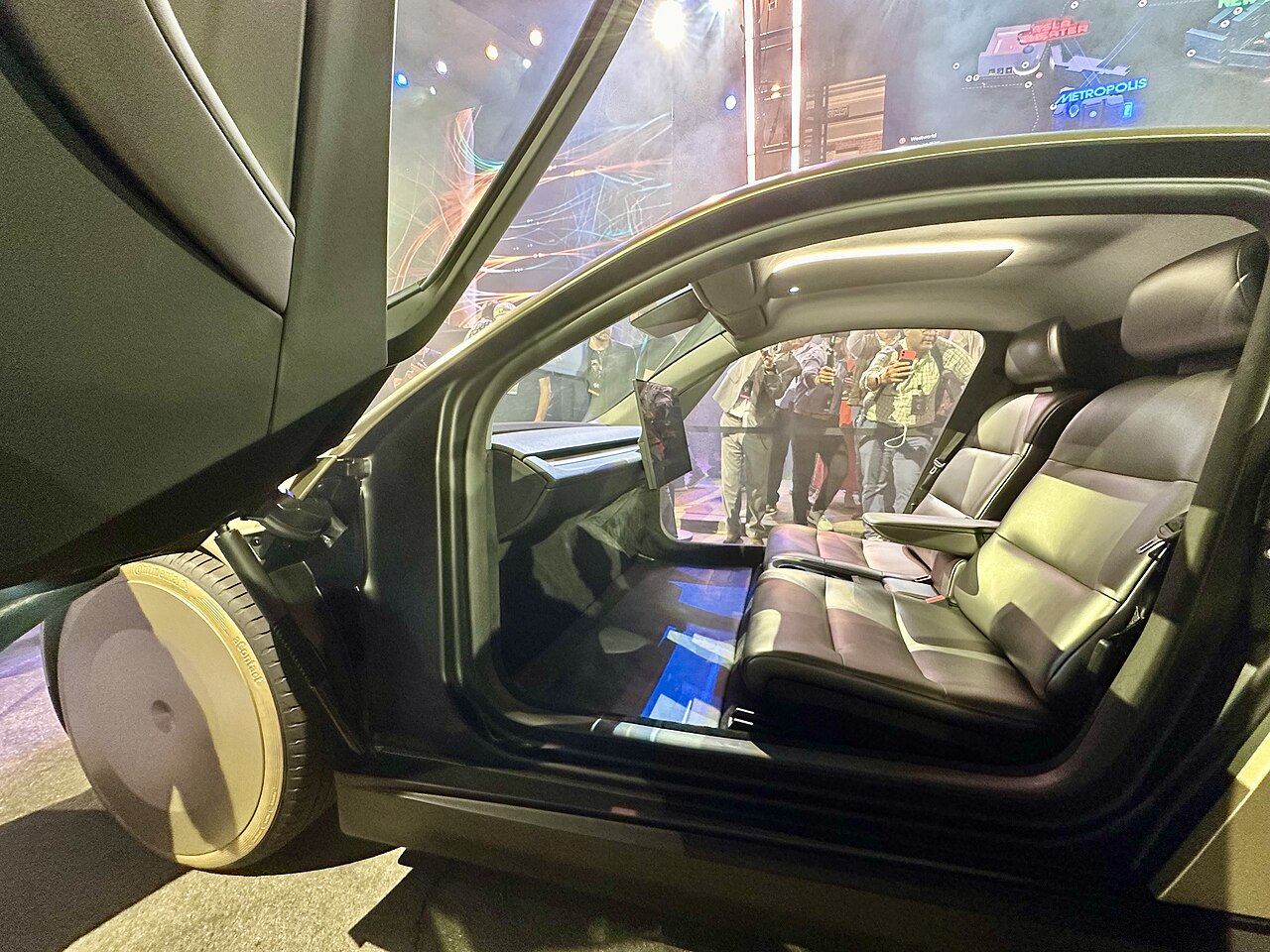
Removing things is the design language throughout. No steering wheel, no pedals, two seats, butterfly doors.
What Tesla added instead points at who the car is for: a low seat height meant to work for wheelchair users, extra trunk volume for assistive devices, braille on the door handles, phone-based door opening and in-cabin voice control. Front, knee and side airbags are all present.
The rider and compliance guides Tesla published alongside the launch put numbers on that design. Legroom is 43.4 inches, more than the 41.8 inches at the roomiest point in a Model Y, and the rear trunk holds 20.2 cubic feet (572 litres) and up to 220 pounds.
Tesla describes that as two checked bags and two carry-ons, or one large folded stroller, or one small folded wheelchair. The dimensions were clearly chosen with a wheelchair user travelling alone, with their equipment, in mind.
This is a vehicle designed around the passenger experience of a taxi rather than the driving experience of a car, and no incumbent automaker has committed to that premise at this scale.
Tesla also opened a commercial channel on the same day.
Tesla also opened a commercial channel on the same day, with no press release and no announcement of any kind. A page appeared quietly on the company website at tesla.com/robotaxi/interest, headed Help Us Build Our Robotaxi Network and inviting visitors to complete an interest form to be considered for future Robotaxi opportunities. Staff circulated the same form to guests at the Austin event.
The form collects a name, email, phone number, company name and the region where the applicant wants to deploy, then asks them to pick a category: Cybercab fleet vehicle purchasing, mobility hubs and infrastructure, event collaboration, or other.
Tesla says a representative will follow up, and the page covers buying a single Cybercab for commercial use as well as a fleet. It is the first public-facing channel the company has ever opened for Cybercab purchases.
Procedurally that is a web form. Strategically it is the clearest signal yet that Tesla does not intend to own and operate every car itself. Until this week the robotaxi business had been kept firmly in-house, first on Model Ys and now on the Cybercab.
Selling vehicles into third-party fleets while taking a platform fee on the rides is the asset-light version of the business, and it is the version that scales fastest if the software holds up.
Two things are worth noting about who is not on that page.
Existing Tesla owners, told for years that they would be able to add their own cars to the network and earn passive income, are still not included; this is a channel for businesses buying purpose-built vehicles, not the owner-operator network Musk has described since 2016.
And Tesla has published no fleet pricing and no delivery timeline, while approval for unsupervised operation still varies state by state.
Why two seats and no steering wheel is fundamentally a cost decision
Every design choice above traces back to a single number: cost per mile. A ride-hailing trip today pays for a driver, a car that is idle most of the day, and a platform margin. Take out the driver and raise utilisation, and the remaining cost is energy, depreciation, insurance, cleaning, depot labour and remote supervision.
Whoever gets that number lowest wins the market, because at low enough cost per mile the service stops competing with Uber and starts competing with car ownership.
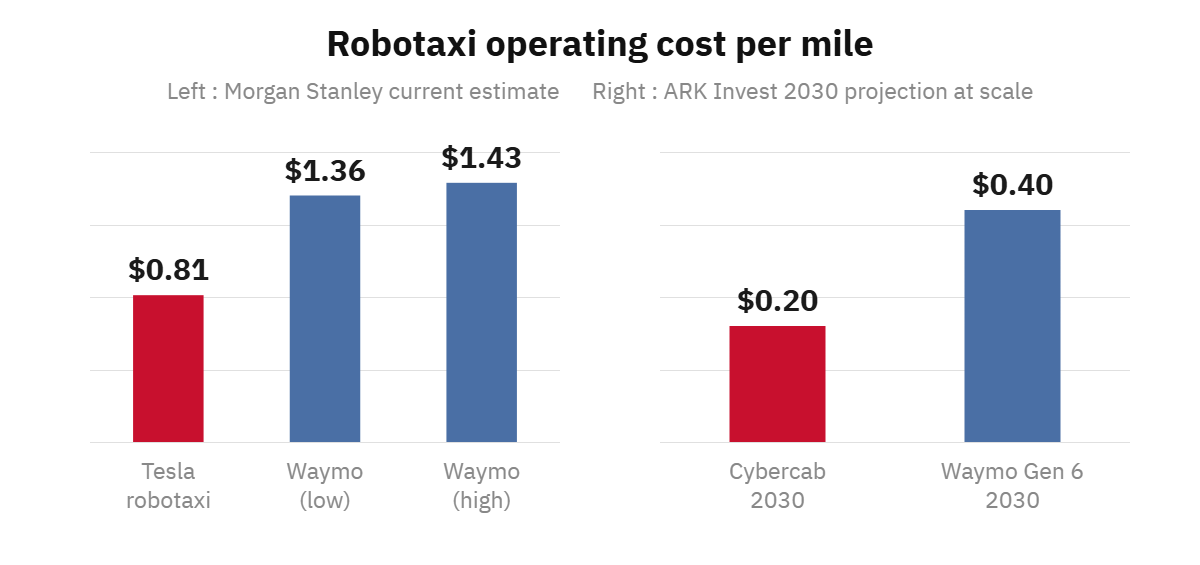
The published estimates give a sense of the gap and its direction. Morgan Stanley has put Tesla current robotaxi operating cost around 0.81 dollars per mile against 1.36 to 1.43 dollars for Waymo, a gap the bank expects to narrow as Waymo sixth-generation hardware scales.
ARK Invest Big Ideas 2026 projects a fully loaded 0.20 dollars per mile for the Cybercab at scale by 2030 against 0.40 dollars for Waymo Gen 6.
Musk called that projection probably true in January, and hours before the Austin event argued that public cost comparisons still do not account for the operational efficiency of the Cybercab.
Treat those forward numbers as what they are, projections from an interested party and a long-time Tesla bull. But the structural logic underneath them is not controversial.
Tesla builds its own vehicles on an existing high-volume line, designs its own inference chips, and runs a camera-and-neural-network sensor stack that costs a fraction of a lidar-and-radar suite. Waymo buys platforms from partners and integrates an expensive sensor package.
If both companies achieve reliable driverless operation, the Tesla bill of materials advantage is real and it compounds across every vehicle in the fleet.
The conditional in that sentence is doing the work, and Tesla knows it. Full Self-Driving is what turns the Cybercab from an unusual-looking car into a business.
Waymo argued in a blog post this week that cameras alone are not sufficient for safe autonomy at scale, which is a direct challenge to the premise the Cybercab is built on. The Tesla answer is that the sensor debate is settled empirically rather than rhetorically, through miles driven with nobody in the driver seat.
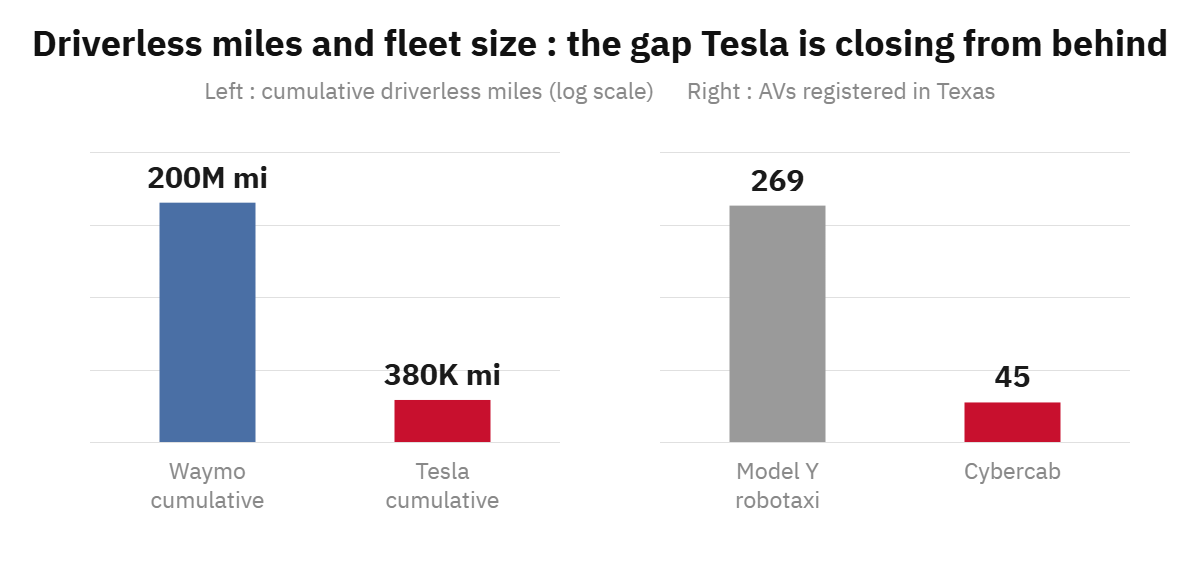
On that measure Tesla is still the challenger. Waymo offers paid rides in 14 US cities with a fleet of roughly 4,000 vehicles, delivers more than 500,000 fully autonomous rides a week and has passed 200 million cumulative driverless miles.
The most recent Tesla earnings disclosure put its unsupervised mileage at roughly 380,000 miles, and one fleet tracker counts about 200 Tesla vehicles nationwide carrying an unsupervised designation. That is a difference of nearly three orders of magnitude, and no amount of favourable framing makes it smaller.
What that comparison omits is the shape of the two curves. Waymo grows city by city with a bespoke, expensive vehicle and a mapping-intensive deployment process.
Tesla is validating a vehicle it can build in six figures a year on a line that already exists, using a stack that inherits data from millions of customer cars running FSD on public roads every day.
Musk has been explicit that the Cybercab needs its own body-specific driving data before large numbers go out, which is a slower and more conservative posture than his rhetoric usually suggests, and the right one.
What Tesla is telling investors to expect, and what to actually watch
The regulatory story is the part of this launch that gets least attention and probably deserves most. Manufacturers who cannot certify a vehicle against every Federal Motor Vehicle Safety Standard must petition NHTSA for a Part 555 exemption, and each exemption is capped at 2,500 vehicles a year.
That ceiling is workable for a demonstration fleet and structurally incompatible with mass deployment; it is the constraint that has shaped competitor rollout plans for years.
Tesla took a different route. Rather than petitioning for relief, it engineered the Cybercab to comply with the standards as written and self-certified, and Tesla VP of vehicle engineering Lars Moravy confirmed on X that the 2,500-unit cap does not apply.
The EPA issued the Cybercab certificate of conformity as a battery-electric zero-emission vehicle in late May.
Meanwhile NHTSA has been moving the rules toward the Tesla position, streamlining Part 555 and the Automated Vehicle Exemption Program in July and signalling updates to the standards covering controls, lighting, mirrors and restraints, after which individual exemptions may not be needed at all.
On pricing, the stated target has been consistent: Musk confirmed in February an intention to sell the Cybercab for 30,000 dollars or less by 2027, against an original 25,000 dollar figure from the 2024 reveal.
Prediction markets have been sceptical, giving roughly 17 to 18 per cent odds on Tesla hitting the sub-30,000 target within this calendar year.
No retail price was confirmed at the Austin event, and there is a reasonable argument that Tesla should not confirm one until the fleet economics are proven on its own balance sheet first.
Expansion is the other open question, and here one hard number does exist. Late last month the Nevada Transportation Authority unanimously approved permits for up to 8,000 driverless vehicles in Clark County over the next twelve months.
Tesla drew by far the largest allocation at roughly 5,000, against 1,000 for Waymo, 1,000 for Uber through its Motional partnership and 100 for Zoox. At the public hearing the Cybercab chief engineer told regulators Tesla expects to field around 2,500 within the year and described 5,000 as a ceiling rather than a target.
That is the first concrete figure attached to a large-scale Cybercab deployment, and it is a useful reality check in both directions.
Twenty-five hundred vehicles in a single metropolitan area would be an order of magnitude beyond anything Tesla runs today, and it would require depots, cleaning, charging and remote support built out at a scale the company has not yet demonstrated.
It is also roughly five times what the federal 2,500-per-year exemption cap would have allowed nationwide, which is precisely why the self-certification route matters.
The service itself now covers Austin, Dallas, Houston, Miami, Orlando and Tampa, plus a Bay Area operation still running with employees behind the wheel on an internal FSD build.
Cybercabs have been photographed well outside those zones in recent days, including a group of around twenty at Miami International Airport and a growing cluster at a showroom outside Philadelphia, a state with no active robotaxi geofence at all.
Texas Department of Transportation executive director Marc Williams has said the Cybercab will dramatically scale Tesla robotaxi operations over the coming months, and Musk teased a storm of Cybercabs on X hours before the event.
So here is what is actually worth tracking over the next quarter, in order. First, whether Cybercab registrations in the Texas registry climb steeply from 45 or plateau. Second, whether public app access to the Cybercab widens beyond limited areas of Austin into the full geofence and then into Dallas, Houston and Florida.
Third, whether Tesla discloses anything concrete on Cybercab unit cost, since a credible cost number would move the thesis further than any demonstration. Fourth, whether NHTSA says nothing about the self-certification, which would be the loudest possible endorsement of the path Tesla chose.
The market read the setup positively: Tesla shares rose 5.4 per cent to 376.37 dollars on the day of the event, though the stock remains down roughly a fifth for the year against a market capitalisation near 1.4 trillion dollars that already prices in a working autonomous network.
Skepticism about timelines is fair and Tesla has earned some of it. But it is worth being clear about what happened on 3 September. A vehicle with no steering wheel, built on a mass-production line, certified against federal standards without an exemption, carried members of the public on public roads in an American city. Every other player in this industry is still working toward some part of that sentence.
References
Reuters / U.S. News, Tesla Says It Is Offering Cybercab Rides in Limited Areas of Austin, Texas (3 Sep 2026)
Teslarati, Tesla opens Cybercab rides to the public, with no steering wheel or pedals (3 Sep 2026)
Teslarati, Tesla hints it is already prepping for Cybercab fleet orders (3 Sep 2026)
TechCrunch, The Cybercab is the Tesla fork in the road moment (3 Sep 2026)
Electrek, Tesla confirms Cybercab production has started (23 Apr 2026)
TechCrunch, Tesla is asking people if they want to buy and run Cybercab fleets (3 Sep 2026)
Electrek, Tesla opens search for Cybercab fleet sales, but FSD owners are still left out (3 Sep 2026)
Yahoo Finance / CNBC, Cybercab Austin launch coverage and Texas DMV driverless registrations (3 Sep 2026)
Nevada Transportation Authority, Clark County autonomous vehicle permit allocations (Aug 2026)
Tech Times, NHTSA Brake Rule Would End Robotaxi Production Cap (26 Jul 2026), EPA certificate specifications
NHTSA, Interim Part 555 Guidance and automated vehicle rulemaking announcement (30 Jul 2026)
ARK Invest Big Ideas 2026; Morgan Stanley robotaxi cost estimates
InsideEVs, Waymo fleet and cumulative driverless mileage reporting
Forbes, Tesla Cybercab Launches With Closed Event, Surprising Some Fans (3 Sep 2026), rider and compliance guide specifications
Tesla, Help Us Build Our Robotaxi Network interest page, tesla.com/robotaxi/interest