Olive oil is the most valuable liquid in most kitchens, and one of the most frequently faked foods in the world. This piece pulls together what university laboratories, police agencies and market analysts have actually found, and turns it into a checklist you can use in a supermarket aisle.
1. Background
Olive oil occupies an unusual position in the pantry. It is simultaneously a commodity cooking fat, a health product people take by the spoonful, and a luxury good with bottles selling for the price of wine. That range is exactly what makes it attractive to fraudsters.
The economics are simple. The gap between the cheapest edible olive oil and a genuine premium extra virgin can be five to ten times. Almost no other everyday grocery item offers that much margin for so little visible difference. A consumer cannot see, and usually cannot taste, the difference between a mediocre oil and an excellent one.
There is a second, more technical reason. The top grade is not defined purely by chemistry. It is defined partly by a sensory panel: trained tasters who must find no defects and must detect fruitiness. The definition of the highest grade therefore depends on human judgement, applied to a product whose quality decays continuously from the day it is pressed. Both facts create room to argue, and room to cheat.
The result is a market where price is a poor signal. Understanding why requires looking at three separate bodies of evidence: laboratory testing, criminal enforcement, and the price data itself.
2. Current State

What the label legally means
Under International Olive Council (IOC) standards, which most producing and importing countries follow in some form, the grades run roughly as follows.
| Grade | How it is made | Key limits |
|---|---|---|
| Extra virgin | Mechanical extraction only, no heat or solvents | Free acidity 0.8% or less, peroxide value 20 or less, zero sensory defects |
| Virgin | Same process, lower quality fruit or handling | Free acidity 2.0% or less, minor defects permitted |
| Lampante | Virgin oil that failed, historically lamp fuel | Not sold to consumers as-is, must be refined first |
| Refined, Pure, Olive oil | Lampante refined with heat and chemistry, blended back with a little virgin oil | Legal and safe, but nearly none of the aroma or antioxidants |
| Light olive oil | Marketing term for heavily refined oil | Light in flavour and colour, not in calories |
Two things follow. Light and pure are not premium tiers, they are refined product. And the entire commercial value of the extra virgin category rests on a sensory judgement that no shopper can verify at the shelf.

The UC Davis results, and what they actually showed
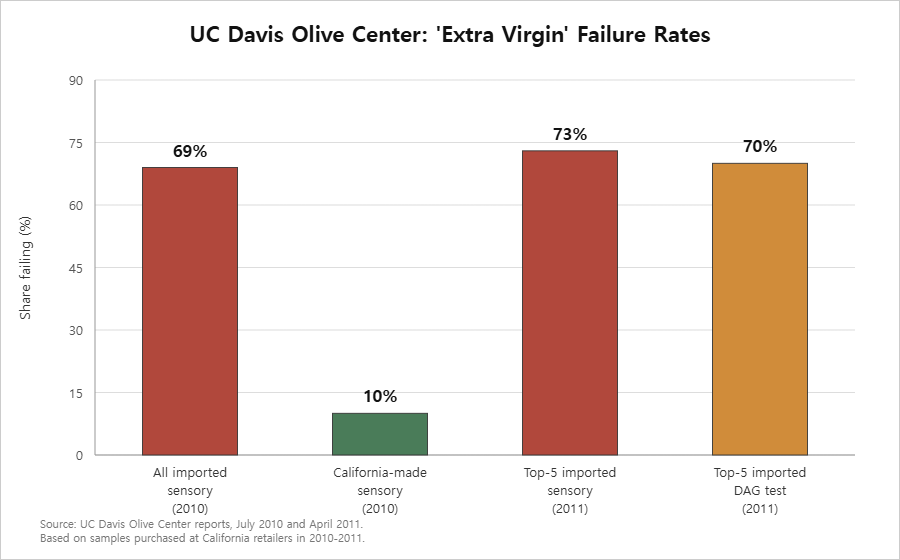
The single most-cited study in this field came from the UC Davis Olive Center. In July 2010 the centre reported that 69 percent of imported oils labelled extra virgin, bought from California supermarkets and warehouse stores, failed the IOC sensory standard. California-produced oils in the same study failed at 10 percent.
A follow-up in April 2011, run with the Australian Oils Research Laboratory and using two IOC-accredited panels instead of one, examined the five best-selling imported brands and found 73 percent of those samples failing the sensory standard. Seventy percent also failed a diacylglycerol test, a marker sensitive to refined-oil blending and to age.
One detail is worth remembering, because it is the origin of a widely repeated consumer story. Among imported brands, Kirkland Signature Organic, Costco’s own label, was the only one whose samples passed the sensory test across all three regions sampled. It was also among the least expensive oils in the study. That single finding has been repeated online for fifteen years, and it is the reason warehouse-club olive oil has a reputation it did not buy with advertising.
Now the caveats, which matter as much as the headline.
- Failed mostly did not mean fake. Most failures were sensory defects such as rancid, fusty and musty, which indicate oil that was oxidised, made from poorly stored fruit, or simply old. Adulteration with cheaper seed oil is a separate and less common finding.
- The sample was small and regional. The 2010 report covered 52 samples across 19 brands, bought in one U.S. state. The IOC criticised the sample size at the time, and the North American Olive Oil Association has pushed back on the framing ever since.
- The data is now fifteen years old. UC Davis prints a note on the reports stating the results should not be used to characterise olive oil currently on shelves.
The correct reading is narrower but still uncomfortable. A large share of supermarket extra virgin is not extra virgin by the time it reaches you, mostly because of age and handling rather than deliberate fakery.
Where the deliberate fraud actually happens
Deliberate adulteration is a documented criminal enterprise, and enforcement records are the clearest evidence.
In 2019, Europol’s intellectual-property crime unit supported Italian NAS Carabinieri and German authorities in an operation that led to 20 arrests and the seizure of 150,000 litres of counterfeit olive oil. The method was blunt: low-grade oil recoloured with chlorophyll and beta-carotene, cut with soya oil, and sold into the Italian and German markets, reportedly worth up to 8 million euro a year to the gang.
In November and December 2023, Operation Omegabad, a spin-off of the Europol and Interpol food-fraud programme OPSON, produced 11 arrests and the seizure of more than 260,000 litres of olive oil declared unfit for consumption. The network bought lampante oil, blended and chemically manipulated it to pass quality checks, falsified the paperwork, and sold it as virgin and extra virgin. The name was sarcastic: bad omega, a reference to the omega-9 content the product conspicuously lacked.
Europol’s own assessment of why it happened is the important part. Price inflation, reduced production and rising demand together created, in their phrasing, ideal conditions for fraudulent producers. Enforcement bodies now list edible oils among Europe’s most frequently adulterated food categories, and OPSON XIII in 2025 again flagged olive oil as a leading target.
The price shock that made fraud profitable
The fraud wave was not random. It tracked a genuine supply crisis.
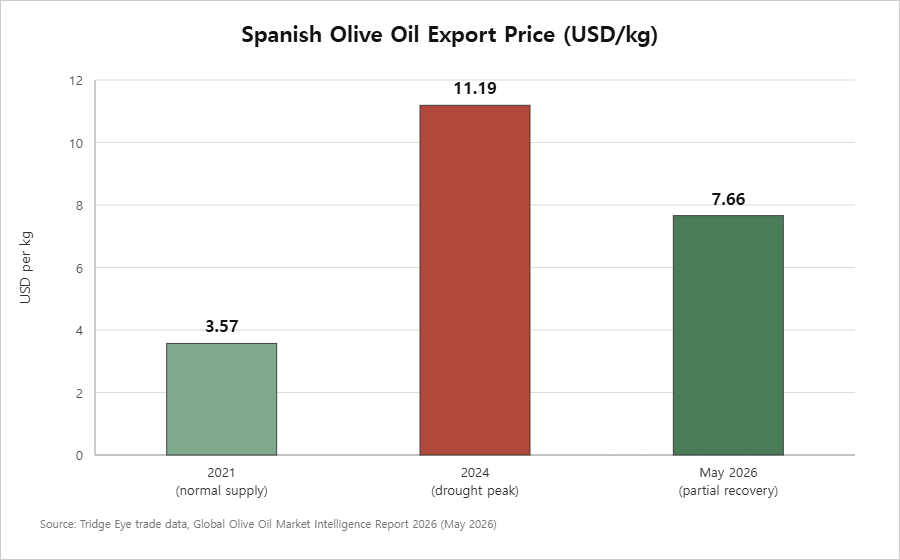
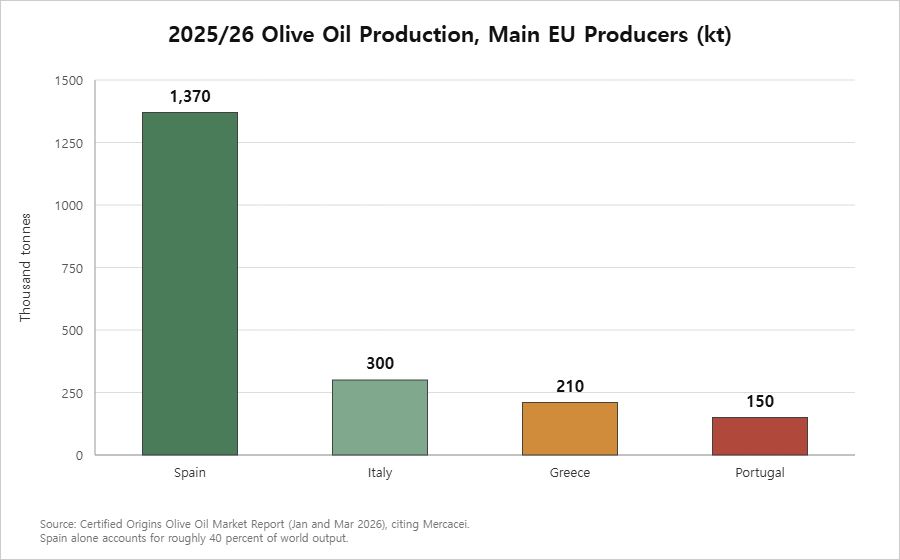
Spain produces roughly 40 percent of the world’s olive oil. A multi-year Mediterranean drought cut that output sharply, and Spanish export prices rose from about 3.57 dollars per kilogram in 2021 to a peak near 11.19 dollars in 2024, an increase of roughly 148 percent driven almost entirely by supply contraction rather than demand.
Harvests have since recovered. Spanish export prices were around 7.66 dollars per kilogram in May 2026, and conventional Spanish extra virgin traded at 4.2 to 4.5 euro per kilogram in the April 2026 market reports, with Italian oil holding a premium at 6.5 to 7.0. Global production for 2025/26 came in near 3.44 million tonnes, about four percent below the prior year but historically high.
The relief is real but conditional. Production costs in traditional Spanish groves now exceed 5 euro per kilogram, which sets a structural floor under prices. Forward indicators are mixed: field assessments in Jaen and Cordoba in mid-2026 pointed to a strong 1.7 to 1.8 million tonne Spanish crop, while the producer association OliveA warned in May 2026 that flowering fertility for 2026/27 was tracking around 37 percent below normal and that stocks were historically low. Both cannot be right, and that disagreement is itself the story. This market is now volatile by default.
Why an expensive bottle is not a safe bottle
Here is the counterintuitive part. Price correlates with positioning, meaning bottle design, origin story and shelf placement, far more reliably than it correlates with laboratory results. A premium price signals that a brand has decided to compete at the top end. It does not signal that anyone independently tested the contents.
- Time. Producers may legally set a best-before date from the bottling date, not the harvest date. Oil can sit in a tank for a year, be bottled, receive a two-year date, and reach you already old. Premium retail channels often turn over stock more slowly than high-volume ones.
- Light and heat. Clear glass looks luxurious and destroys oil. So does a bottle displayed under retail lighting for months.
- Supply chain distance. A brand that buys bulk oil, blends it and puts its own label on it has less control over the fruit than a producer that mills its own olives, regardless of what the bottle costs.
Conversely, a large private-label buyer can outperform. High turnover means fresher stock. A single buyer purchasing enormous volume has leverage to demand testing and to reject lots. And a retailer whose entire brand equity rides on its own label carries reputational exposure a small importer does not. That is the structural reason a warehouse-club oil could beat premium imports in a blind panel. Not luck, but incentives.
3. Future Outlook

Detection is moving from is this olive oil to which grove is this from. The traditional chemical tests were designed to measure quality, not to catch sophisticated blending, and a competent fraudster can formulate around them. Nuclear magnetic resonance fingerprinting combined with stable isotope ratio analysis and multivariate statistics has been shown to classify oils by region of origin with accuracies in the high 80s to high 90s percent in published work. The limiting factor is not the physics but the reference database, which must be rebuilt each harvest year because the isotope signature reflects that year’s climate.
Traceability infrastructure is being built. Work published in 2024 from the Agricultural University of Athens demonstrated a blockchain and IoT traceability system specific to the olive oil supply chain, using smart contracts to record quality metrics from grove to bottle in tamper-resistant form. Expect QR-code provenance to move from a marketing feature on premium bottles to an expectation on mid-tier ones.
Climate is the structural risk. The 2023 to 2024 shock demonstrated that a single bad year in Andalusia can reprice the global market. With production costs establishing a floor above 5 euro per kilogram and weather variability increasing, sharp price cycles are likely to repeat. Every price spike creates fresh incentive for fraud. The two move together.
The map of origin is widening. Tunisia asked in early 2026 to raise its zero-duty EU export quota from 56,700 to 100,000 tonnes a year, and Tunisian extra virgin has been trading well below Spanish levels. Portugal, Turkey, Australia, Chile, Argentina and California continue to expand. More origins means more price competition, and also more opportunity to obscure where oil actually came from.
The market is splitting in two. On one side, olive oil as a commodity fat competing with seed oils on price. On the other, a small, expensive, tested, traceable, high-phenolic tier sold on measurable content. The confusing middle, attractive bottles with romantic labels and no verification, is where consumers currently lose the most money.
4. What It Means for Your Kitchen
What you are actually paying for
The health interest in extra virgin olive oil is not really about the fat. Refined olive oil has a nearly identical fatty-acid profile at a fraction of the price. What you pay extra for is the phenolic compounds, including hydroxytyrosol, tyrosol, oleuropein, oleocanthal and oleacein, which survive only in unrefined oil and decline steadily with age, heat and light exposure.
The evidence sits at different levels of confidence, and it is worth separating them.
- Strong: a Mediterranean dietary pattern including generous olive oil is associated with reduced cardiovascular risk. This is dietary-pattern evidence, not a claim about any single spoonful.
- Moderate: the European Union permits a health claim about protection of blood lipids from oxidative damage for oils delivering at least 5 mg of hydroxytyrosol and derivatives per 20 g of oil, a threshold many supermarket oils do not meet.
- Early: effects on inflammation, insulin sensitivity, mitochondrial function and neuroprotection are supported largely by cell, animal and small human studies. Oleocanthal’s much-repeated ibuprofen-like mechanism comes from a 2005 laboratory finding, not from clinical outcome trials.
On the popular habit of taking a spoonful on an empty stomach in the morning, there is no good trial showing that timing or the empty stomach adds anything over consuming the same oil with food, and a tablespoon carries roughly 120 calories. If the habit gets more good oil into your diet, it is harmless. It is not, on current evidence, a therapy, and taking a degraded oil that way delivers the calories without the compounds you were paying for.
The buying checklist
- Harvest date, not best-before date. This is the single most useful line on a label, and its absence is itself information. Aim for oil within 12 to 18 months of harvest.
- Dark glass or tin. Clear bottles are a quality decision, and a bad one. Never buy oil in clear plastic.
- A named mill, estate or region. Bottled in and packed in are not origin statements. Product of EU means bulk oil of unstated provenance.
- A third-party seal. COOC in California, PDO or PGI in the EU, NAOOA certification, or an equivalent national scheme. Organic certification covers farming method only and says nothing about freshness or grade.
- A price that makes sense. Given production costs above 5 euro per kilogram in traditional groves, an extra virgin selling far below the market floor is telling you something.
- Taste it. Good extra virgin is fruity, noticeably bitter, and produces a peppery catch at the back of the throat that can make you cough. That burn is the phenolics. Oil that tastes of nothing but grease, or tastes of crayon, old nuts or damp cardboard, is defective, whatever it cost.
Three myths worth discarding
- The refrigerator test. Putting oil in the fridge to see if it solidifies does not indicate authenticity. Different cultivars and waxes behave differently, and adulterated oils can pass. UC Davis has explicitly rejected it.
- Colour. Green means chlorophyll content and cultivar, not quality. Professional panels use coloured glasses precisely so that colour cannot bias the judgement.
- First cold pressed. Modern mills use continuous centrifuges. There is no second press. The phrase is a historical artefact used as marketing.
Once it is home
Treat olive oil as perishable. Store it in a dark cupboard away from the stove, not on the counter beside it. Buy a size you will finish in two to three months after opening, since oxidation accelerates once air enters the bottle. Use extra virgin for finishing, dressing and normal sauteing, since its antioxidants make it more heat-stable than its reputation suggests, while keeping a cheaper refined oil for deep frying where the flavour and phenolics would be destroyed anyway.
5. Conclusion
Three findings survive scrutiny. A large share of oil sold as extra virgin does not meet that standard at the point of sale, mostly through age and oxidation rather than criminal adulteration. Deliberate fraud is real, organised, and rises reliably whenever prices spike, as they did dramatically between 2021 and 2024. And price is one of the weakest available predictors of whether a given bottle is any good.
The Kirkland result from 2010 is a useful illustration precisely because it is counterintuitive. The cheapest imported oil in the study was the only imported brand to pass every sensory panel. But it should be read as evidence about incentives rather than as a permanent buying instruction. Fifteen-year-old test results do not certify today’s bottle from any producer.
What travels is the method. Verifiable information beats price, and beats packaging: a harvest date, a named origin, a dark bottle, an independent seal, and a peppery finish that makes you cough. Those five signals cost nothing to check and outperform every assumption about what expensive olive oil must contain.
References
UC Davis Olive Center, “Tests indicate that imported extra virgin olive oil often fails international and USDA standards”, July 2010
UC Davis Olive Center and Australian Oils Research Laboratory, “Evaluation of Extra-Virgin Olive Oil Sold in California”, April 2011
University of California, Davis, “Imported olive oil quality unreliable, study finds”, news release
North American Olive Oil Association, “The Facts About UC Davis Olive Center’s Olive Oil Report”
Europol, “150,000 litres of fake extra virgin olive oil seized from a well-oiled gang”, June 2019
Europol, “Operation Omegabad”, OPSON spin-off investigation, December 2023
Food Safety News, “Spanish and Italian investigators uncover olive oil fraud”, December 2023
FoodNavigator, “Olive oil a major target for food fraud”, Operation OPSON XIII, May 2025
Tridge, “Global Olive Oil Market Intelligence Report 2026”, May 2026
Certified Origins, “Olive Oil Market Report”, January, March, April and June 2026
V. Vitaskos, K. Demestichas, S. Karetsos, C. Costopoulou, “Blockchain and Internet of Things Technologies for Food Traceability in Olive Oil Supply Chains”, Sensors 24(24):8189, December 2024
C. Maestrello et al., “Nuclear magnetic resonance spectroscopy in extra virgin olive oil authentication”, Comprehensive Reviews in Food Science and Food Safety, 2022
International Olive Council, Trade Standard Applying to Olive Oils and Olive Pomace Oils
California Olive Oil Council, certification criteria
Korea Consumers Union, extra virgin olive oil quality and safety evaluation, 2013
This article is general information, not medical or dietary advice. Product findings cited from 2010 to 2011 testing describe those samples at that time and are not a current assessment of any brand.